Job profitability software
Connect the price you signed with the cost you delivered.
Centrov keeps the commercial plan and operational record close enough to explain why a job’s result moved after the quote was won.
Centrov keeps the commercial plan and operational record close enough to explain why a job’s result moved after the quote was won.
Job profitability compares revenue with the cost of delivering a specific contract. For a labour-based service, useful context includes approved hours, wages, employment costs, supplies and operating overhead. The comparison is strongest when it uses the same assumptions that informed the original quote.
Illustrative cleaning workflow
Keep the $4,560 monthly cleaning price and 120 labour hours fixed. In this example, four of those planned hours carry a 50% wage premium at a $22 base wage, plus the modelled 18% employment-cost allowance.
| Cost or result | Quoted | Actual example |
|---|---|---|
| Revenue before tax | $4,560.00 | $4,560.00 |
| Hours worked | 120 | 120 |
| Additional wage premium | $0.00 | $44.00 |
| Employment costs on premium | $0.00 | $7.92 |
| Total modelled cost | $3,919.20 | $3,971.12 |
| Operating contribution | $640.80 · 14.1% | $588.88 · 12.9% |
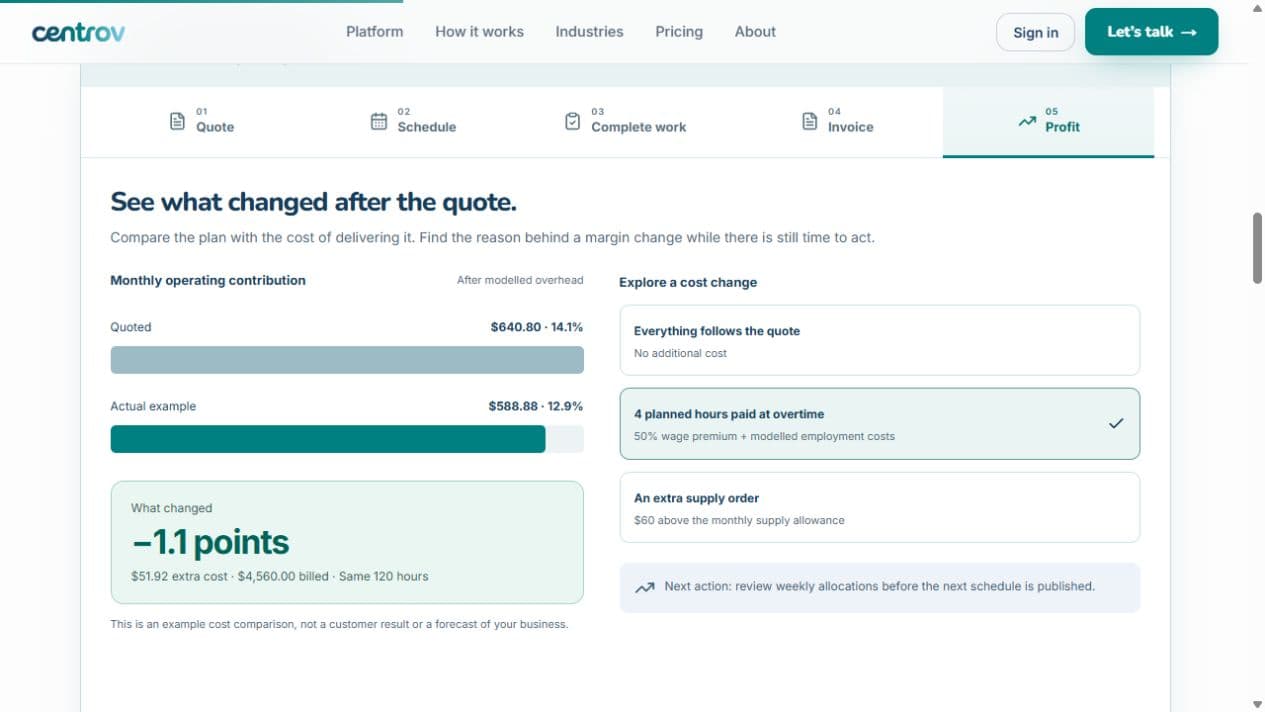
The difference is $51.92, or 1.14 percentage points of revenue. Review the weekly allocation and the reason for the premium. The 18% allowance is illustrative; operating contribution is not net profit.
A large invoice does not reveal overtime, extra hours or unplanned supply cost.
Comparisons become unreliable when the pricing sheet and financial report use different cost definitions.
Managers need the reason for a margin change while they can still adjust the operating plan or renewal.
Keep the contract price and quote assumptions connected to the job.
Use reviewed operational records as the basis for delivered labour.
Compare wages, burden, supplies and overhead on the same basis used by the product’s financial views.
Identify changes such as additional hours, overtime or supply cost.
Adjust staffing, the service plan or the next commercial conversation.
Quote and operational reports use connected definitions instead of competing spreadsheets.
Review a specific contract as well as the wider book of work.
Move from a changed percentage to the hours and costs behind it.
Not always. Centrov distinguishes delivery economics and operating contribution so the operator can see which costs are included in each view.
Yes. The product connects signed commercial assumptions with approved operational records for comparison.
Centrov provides operational job and portfolio context. The accounting system remains the formal general ledger and company books.
Bring a real job or contract if you want to examine the numbers and handoffs. It is optional.
A 30-minute walkthrough with a real person. Use our example or bring a contract — entirely optional.