Quoting & job costing
How to Price a Commercial Cleaning Contract in Canada
Build the price from the work outward: labour hours, employer costs, supplies, overhead and the contribution the contract must earn.
Monthly price before tax = loaded labour cost + supplies and equipment + allocated operating overhead + planned operating contribution.
When you start with a target margin, use price = total monthly cost ÷ (1 − target margin). A 15% margin means dividing cost by 0.85—not adding a 15% markup.
Turn the scope into labour hours
Start with what the client is buying: tasks, frequencies, service standard and constraints. Record the cleanable areas and production assumptions, but do not let a square-foot rate replace the walkthrough.
A useful monthly labour plan includes recurring cleaning time plus opening and closing procedures, stocking, equipment setup, internal travel, quality checks, periodic work and realistic supervision. If the building has restricted access, elevators, multiple floors or occupied areas, include the time those conditions consume.
Square footage remains a valuable reasonableness test. Use a production rate to estimate the first version of the hours, then change it when the actual building, surfaces and service specification justify a different number.
Calculate loaded labour—not wages alone
The cleaner’s hourly wage is only the base. The employer also carries payroll and employment costs that can include employer CPP or QPP contributions, employer EI premiums, vacation pay, public-holiday cost, workers’ compensation, benefits, paid training and other applicable obligations.
The Canada Revenue Agency publishes current payroll deduction and contribution guidance and the T4032 payroll tables. Use the worker’s province of employment and current year rather than copying an old percentage into every quote.
Employment standards also vary. For example, Ontario’s guide states that most employees earn overtime after 44 hours in a work week at 1½ times the regular rate, subject to exceptions and special rules. Ontario vacation pay is generally at least 4% of wages for employees with less than five years of employment and 6% at five years or more. Confirm what applies in your province and to the worker involved.
Add supplies, equipment and operating overhead
Keep direct contract costs separate from company overhead. Chemicals, consumables, liners, paper products, equipment rental and contract-specific travel belong against the job when the contract causes them. Estimate periodic work and equipment replacement rather than waiting for a large purchase to surprise one month.
Operating overhead is the cost of having a company capable of delivering the work: office payroll, insurance, software, vehicles, rent, professional fees, sales effort, recruiting and management time. Allocate it consistently—per labour hour, by revenue, or with another method your accountant supports—and review it as the business changes.
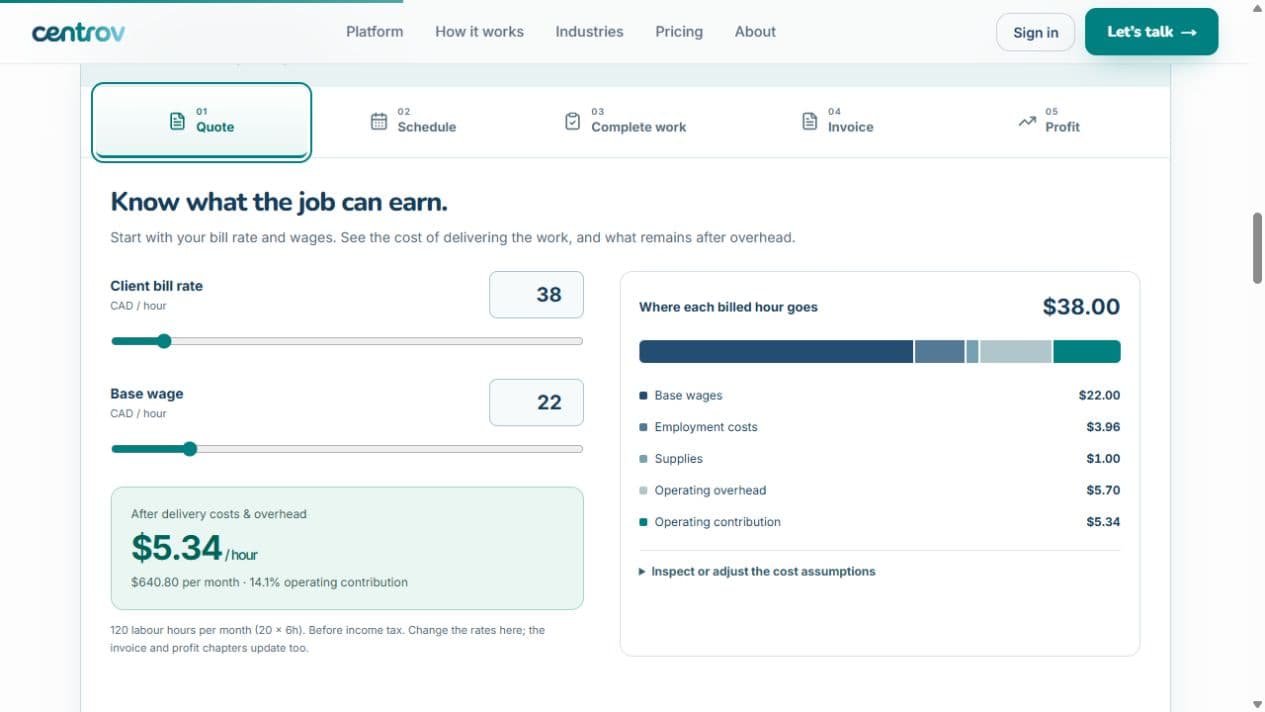
In the worked example, supplies are modelled at $1.00 per labour hour and operating overhead at $5.70. Across 120 hours, that is $120.00 in supplies and $684.00 in allocated overhead.
Choose margin deliberately—and do not confuse it with markup
Margin is the portion of the selling price left after the costs in your model. Markup compares that contribution with cost. They answer different questions.
| Measure | Formula | Example |
|---|---|---|
| Margin | (Price − cost) ÷ price | $635.29 ÷ $4,235.29 = 15% |
| Markup | (Price − cost) ÷ cost | $635.29 ÷ $3,600 = 17.65% |
If total monthly cost is $3,600 and the target margin is 15%, the required price is $3,600 ÷ 0.85 = $4,235.29. Merely adding 15% produces $4,140 and a margin of about 13.0%.
There is no universal “correct” cleaning margin. Consider service risk, payment terms, night supervision, contract concentration, equipment exposure and how much uncertainty remains in the scope.
A 120-hour monthly cleaning contract
The live Centrov illustration uses a $38.00 hourly client rate and 120 monthly labour hours, creating $4,560.00 in monthly revenue before tax.
| Component | Per hour | Per month |
|---|---|---|
| Base wages | $22.00 | $2,640.00 |
| Modelled employment costs | $3.96 | $475.20 |
| Supplies | $1.00 | $120.00 |
| Allocated operating overhead | $5.70 | $684.00 |
| Operating contribution | $5.34 | $640.80 |
| Client price | $38.00 | $4,560.00 |
The planned operating contribution is $640.80, or about 14.1% of revenue. It is not a promise of net profit: financing, taxes, owner compensation and costs outside this operating model may still remain.
Compare the quote with actual delivery
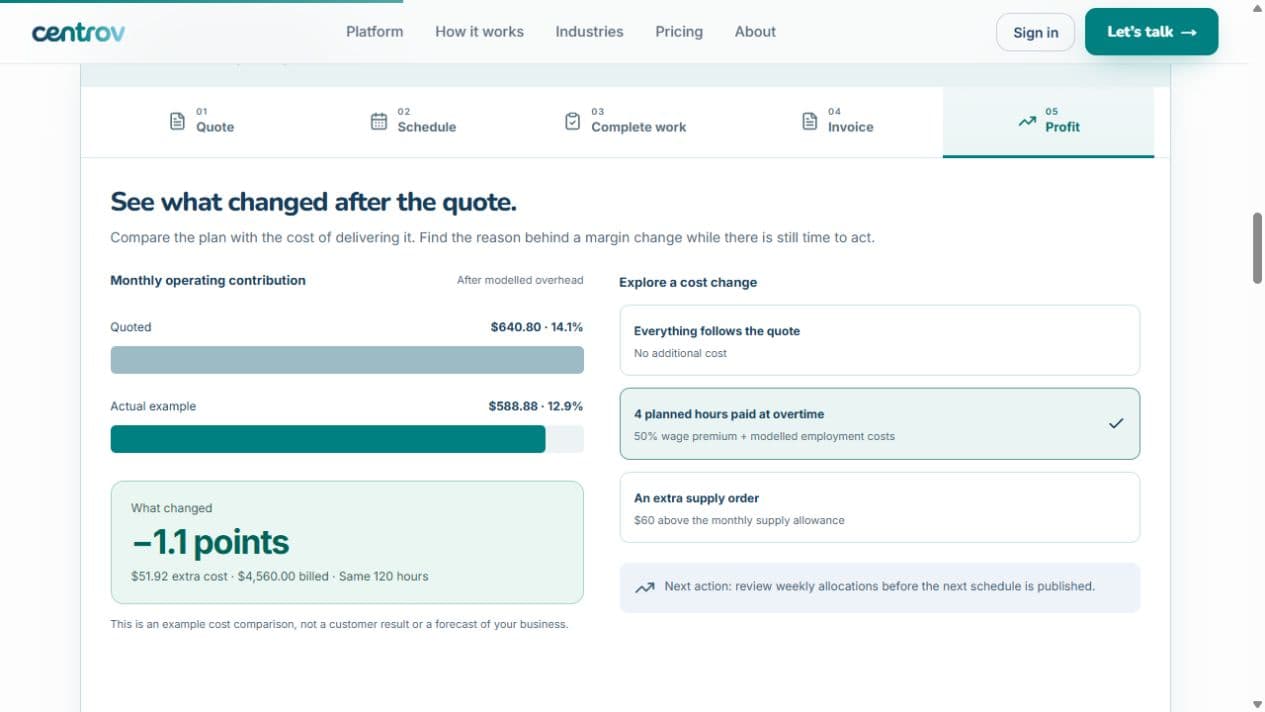
A profitable-looking quote is still an assumption. Once the job begins, compare approved hours, overtime, supply purchases and service exceptions with the original plan. Keep the scope and commercial assumptions attached to the same job record so the comparison survives staff changes and renewals.
In the example above, four overtime hours do not change the invoice. They increase delivery cost by $51.92 and reduce the modelled operating margin by roughly 1.1 percentage points. That is the kind of variance an operator can act on before it becomes a year-long habit.
See how Centrov connects quoted assumptions with job profitability, or review the full cleaning quote and job-costing workflow.
Eight common commercial cleaning pricing mistakes
- Pricing the floor area without validating labour hours. A rate per square foot cannot see access rules, congestion, service frequency or quality expectations.
- Treating wages as total labour cost. Employer contributions, vacation pay, workers’ compensation and other applicable costs still exist.
- Using markup when the target is margin. The percentage base is different, so the price will be lower than intended.
- Forgetting non-cleaning time. Setup, travel within the building, stocking, inspections and close-out all use paid time.
- Ignoring overtime and relief coverage. A schedule that works only when nobody is absent is not a complete cost plan.
- Hiding direct supplies inside overhead. Contract-specific consumption should move with the job so it can be examined later.
- Leaving scope changes informal. Define what triggers repricing, especially when frequency, occupancy or client standards change.
- Never comparing plan with actual. Renewals should use evidence from delivery, not the assumptions from last year’s spreadsheet.
Commercial cleaning quote checklist
- Walkthrough notes and cleanable areas recorded
- Tasks, frequencies and exclusions are explicit
- Monthly visits and labour hours are calculated
- Setup, supervision and internal travel are included
- Base wage matches the planned roles and shifts
- Current employer payroll costs are reviewed
- Overtime and relief-coverage risk is considered
- Supplies, equipment and periodic work are included
- Operating overhead uses a consistent allocation
- Margin—not markup—matches the pricing decision
- Payment terms and scope-change rules are written
- A process exists to compare actual cost with quote
Commercial cleaning pricing FAQ
What is the basic formula for pricing a commercial cleaning contract?
Estimate the monthly labour hours, multiply them by a loaded labour cost that includes employer costs, add supplies, equipment and allocated overhead, then add the operating contribution required for the risk and service level. If you work from a target margin, divide total cost by one minus the target margin.
Should a commercial cleaning quote use square feet or labour hours?
Square footage is a useful scope check, but labour hours connect the building to wages, payroll costs and schedule capacity. Use production rates to estimate hours, then validate those hours against a walkthrough, frequencies, surfaces, congestion and service standards.
What profit margin should a cleaning contract have?
There is no responsible universal percentage. The required margin depends on service risk, contract size, supervision, equipment, payment terms, competitive conditions and the company’s overhead. Use a deliberate target and compare actual delivery with the quote after work begins.
Are CPP, EI and vacation pay part of the employee wage?
They are not part of the base hourly wage used in this guide. Employer CPP or QPP contributions, employer EI premiums, vacation pay and applicable workers’ compensation are separate employment-cost inputs. Current rules and maximums must be checked for the worker and province of employment.
Verify the current rules
- Canada Revenue Agency — Calculate payroll deductions and contributions
- Canada Revenue Agency — T4032 payroll deduction tables
- Ontario — Overtime pay
- Ontario — Vacation time and vacation pay
This guide is general operational information, not payroll, tax, accounting or legal advice. Rules, rates, classifications and exemptions change by year, province and worker. Confirm the current requirements with the relevant authority and your professional advisers before relying on a quote.
Bring one real contract
See the cost assumptions before the quote leaves your desk.
Walk through your labour plan, employer costs, supplies and overhead with the working Centrov product. A real contract is welcome, but optional.
Talk about your operation