Build a cleaning quote with every cost in view.
Centrov turns the service plan into labour hours and cost context before the price reaches a prospect. The signed assumptions remain connected to the job for later comparison.
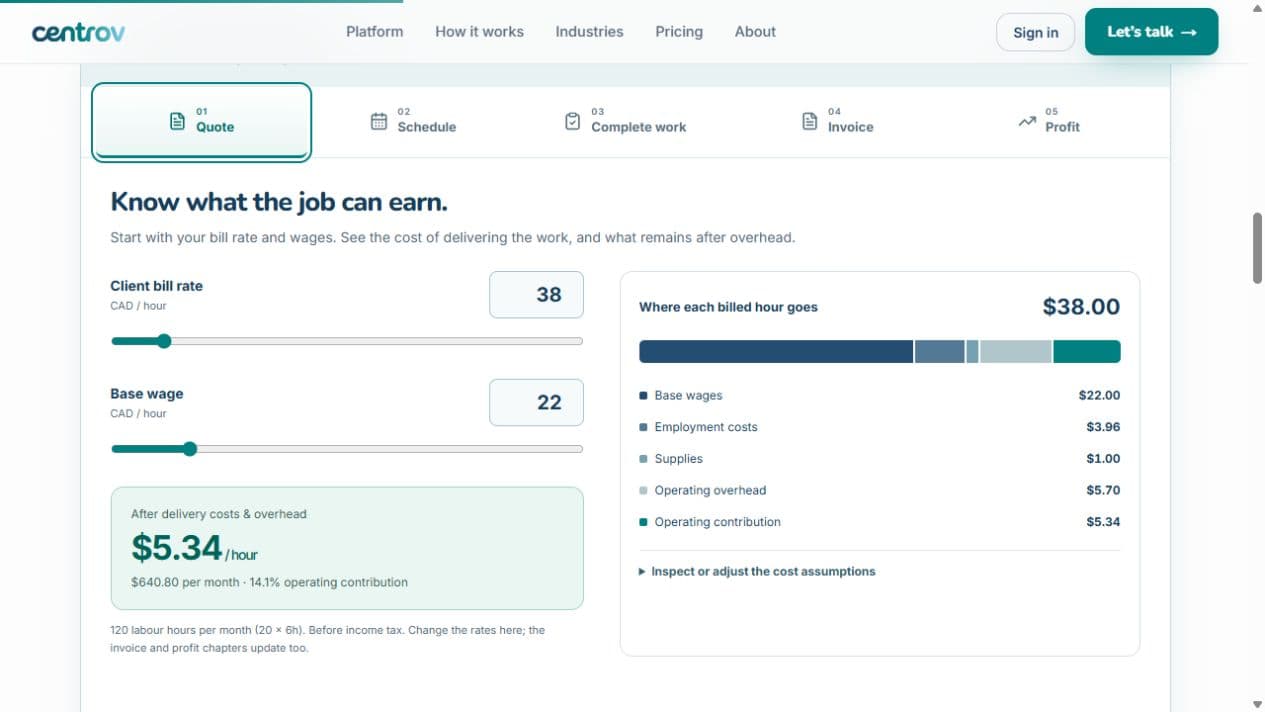
A useful cleaning quote starts with the work and frequency, estimates the labour required, applies wage and employment-cost assumptions, includes supplies and operating overhead, and shows what remains at the proposed price. Centrov exposes those inputs so the operator can review the economics instead of relying on a hidden flat-rate guess.
Suppose one building needs 20 visits a month, with six labour hours per visit. At an illustrative client rate of $38 CAD per hour, the monthly quote is $4,560 before tax. Here is what that price needs to cover.
| Cost or result | Monthly |
|---|---|
| Base wages: 120 hours × $22 | $2,640.00 |
| Modelled employment costs: 18% of wages | $475.20 |
| Supplies: 120 hours × $1 | $120.00 |
| Allocated overhead: 120 hours × $5.70 | $684.00 |
| Total modelled cost | $3,919.20 |
| Operating contribution | $640.80 |
| Client quote | $4,560.00 |

The model leaves $640.80, or 14.1% of revenue, after the costs shown. The 18% employment-cost allowance is an example, not a statutory rate. Review your own costs and read the guide’s assumptions before pricing a contract.
Operating contribution is not net profit. Taxes, financing and any costs outside this model may still remain.
A competitive monthly number can conceal an unrealistic labour plan or missing operating expense.
Base wage alone does not represent the full cost of employing and supporting the people who deliver the work.
When assumptions do not carry into operations, managers cannot explain why the delivered result changed.
Capture the scope, frequency and labour plan for the job.
Review employment burden, supplies and operating overhead using the business’s configured inputs.
See the cost per hour and intended contribution at the proposed bill rate.
Create a client-facing quote while retaining the internal calculation.
Trace approved hours and costs back to the signed commercial plan.
The operator can examine the numbers behind the price.
The won quote becomes a contract connected to the durable job record.
Actual delivery gives the next pricing conversation concrete context.
Yes. The operational quote uses configured business inputs rather than treating a generic illustrative rate as your result.
Yes. Quote economics update with the pricing and cost inputs so the operator can inspect the effect before sending.
No. Client-facing quote output is separated from internal costing information.
Bring a real job or contract if you want to examine the numbers and handoffs. It is optional.
A 30-minute walkthrough with a real person. Use our example or bring a contract — entirely optional.